HOMEPAGE | GALLERY | B.T.GUNNER | HISTORY | PLANES | COMMENTS | BLOG | MAIL

Showing posts with label B-17. Show all posts

Sunday, May 27, 2012

A Special B-17 and Her Crew In 1943

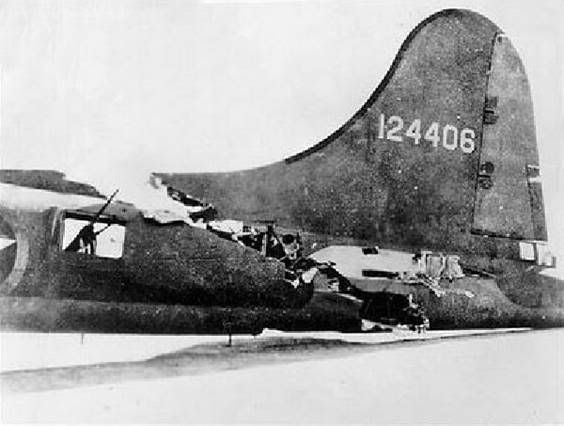
A mid-air collision on February 1, 1943, between a B-17 and a German fighter over the Tunis dock area, became the subject of one of the most famous photographs of World War II.

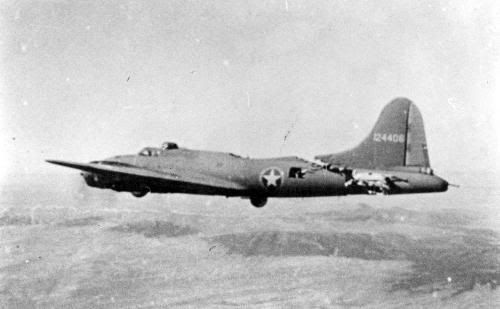
An enemy fighter attacking a 97th Bomb Group formation went out of control, probably with a wounded pilot then continued its crashing descent into the rear of the fuselage of a Fortress named All American, piloted by Lt. Kendrick R. Bragg, of the 414th Bomb Squadron.

When it struck, the fighter broke apart, but left some pieces in the B-17. The left horizontal stabilizer of the Fortress and left elevator were completely torn away. The two right engines were out and one on the left had a serious oil pump leak. The vertical fin and the rudder had been damaged, the fuselage had been cut almost completely through connected only at two small parts of the frame and the radios, electrical and oxygen systems were damaged. There was also a hole in the top that was over 16 feet long and 4 feet wide at its widest and the split in the fuselage went all the way to the top gunners turret.


Although the tail actually bounced and swayed in the wind and twisted when the plane turned and all the control cables were severed, except one single elevator cable still worked, and the aircraft still flew - miraculously! The tail gunner was trapped because there was no floor connecting the tail to the rest of the plane. The waist and tail gunners used parts of the German fighter and their own parachute harnesses in an attempt to keep the tail from ripping off and the two sides of the fuselage from splitting apart. While the crew was trying to keep the bomber from coming apart, the pilot continued on his bomb run and released his bombs over the target.


When the bomb bay doors were opened, the wind turbulence was so great that it blew one of the waist gunners into the broken tail section. It took several minutes and four crew members to pass him ropes from parachutes and haul him back into the forward part of the plane. When they tried to do the same for the tail gunner, the tail began flapping so hard that it began to break off. The weight of the gunner was adding some stability to the tail section, so he went back to his position.

The turn back toward England had to be very slow to keep the tail from twisting off. They actually covered almost 70 miles to make the turn home. The bomber was so badly damaged that it was losing altitude and speed and was soon alone in the sky. For a brief time, two more Me-109 German fighters attacked the All American. Despite the extensive damage, all of the machine gunners were able to respond to these attacks and soon drove off the fighters. The two waist gunners stood up with their heads sticking out through the hole in the top of the fuselage to aim and fire their machine guns. The tail gunner had to shoot in short bursts because the recoil was actually causing the plane to turn.

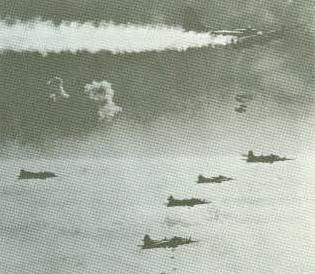
Allied P-51 fighters intercepted the All American as it crossed over the Channel and took one of the pictures shown. They also radioed to the base describing that the empennage was waving like a fish tail and that the plane would not make it and to send out boats to rescue the crew when they bailed out. The fighters stayed with the Fortress taking hand signals from Lt. Bragg and relaying them to the base. Lt. Bragg signaled that 5 parachutes and the spare had been "used" so five of the crew could not bail out. He made the decision that if they could not bail out safely, then he would stay with the plane and land it.

Two and a half hours after being hit, the aircraft made its final turn to line up with the runway while it was still over 40 miles away. It descended into an emergency landing and a normal roll-out on its landing gear.

When the ambulance pulled alongside, it was waved off because not a single member of the crew had been injured. No one could believe that the aircraft could still fly in such a condition. The Fortress sat placidly until the crew all exited through the door in the fuselage and the tail gunner had climbed down a ladder, at which time the entire rear section of the aircraft collapsed onto the ground. The rugged old bird had done its job.

Other B-17 Fuselage Hits from Dave's Warbirds,

Tuesday, November 23, 2010

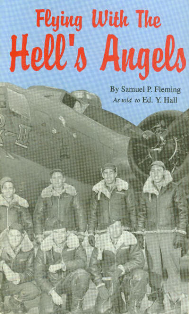
Flying With the Hell's Angels


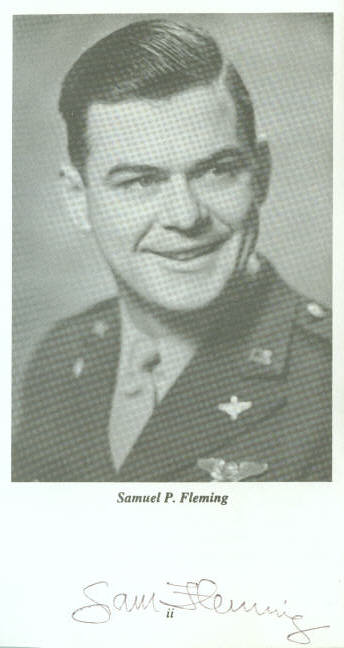
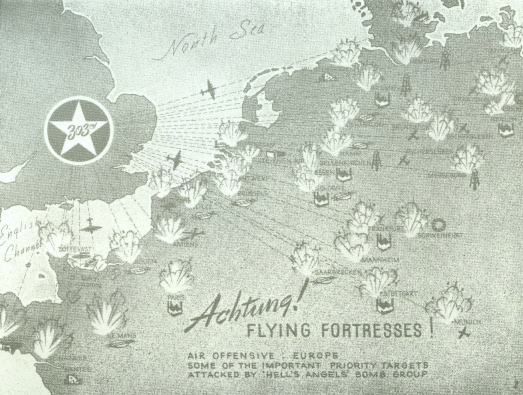
"Flying With the Hell's Angels" is the story of Dr. Sam Fleming and his experiences during World War II as a B-17 Flying Fortress Navigator, 303rd Bombardment Group(H) Eighth Air Force (1943-1944). Ed Y. Hall took Fleming's story and turned it into the book.

Many of Sam's friends suggested that he dictate a summary of his experiences during his tour of duty in the Army Air Corps during World War II, but it took him years to make the decision. Much of this book is based on notes from his small diary, his memory, military records, friends and input from crewmates. This book is his memoirs of the long experiences as a young navigator on one of the greatest war planes to ever fly against an enemy - the B-17 Flying Fortress.


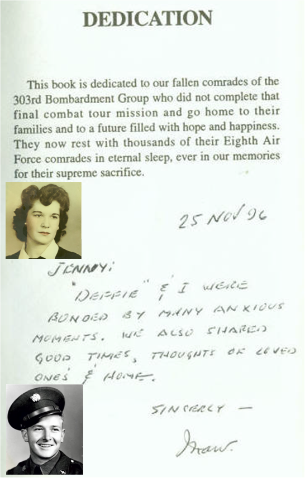
Dr. Sam Fleming evidently knew my grandfather, John Paul Deffinger, and included a note in his book that he gave to my grandmother, Genevieve Deffinger (Jenny). I've been told that my grandfather's nickname was "Deffie". ---Michelle Deffinger

Dr. Sam Fleming's quest began when he left Lanford Station to attend Furman University. After graduating from Furman, it was clear to Fleming that military service was inevitable. He had heard that the Army Air Corps had a special program providing medical training, the 22-year-old aspiring physician paid a visit to a Spartanburg recruiter. "That recruiting sergeant must have needed a few more bodies to make his quota," Fleming muses, "because he signed me up, assuring me that even though he'd never heard of the medical training program, that he was sure someone at my first duty assignment would be able to tell me all about it."

On Aug. 1, 1942, Fleming reported to active duty at Fort Jackson. When he left the military on Oct. 7, 1945, he was still looking for someone who knew something about that elusive medical program.

Fleming had kept a diary during his months in Fortress Europe, despite warnings that doing so was inadvisable, and his family and friends had often urged him to "decipher" the personal account so others could read it. Hall, a member of Wofford College's administrative staff, had already published an account of his own tour of duty as a military adviser in Vietnam, titled "Valley of the Shadow," and was immediately fascinated with Fleming's story.

"I was struck with the uniqueness of Sam's experience," he says of their first conversation. "He was flying at one of the most dangerous times of the air war. It was like Russian roulette every time he went up. He was spinning that cylinder with each mission." Although the memoir provides background, the narrative focuses on the three-month period from Jan. 29, 1944, to April 27, 1944, the 87 days in which his 10-man bomber crew completed 30 missions over the European theater of war. As part of the 303rd Bomb Group, dubbed "The Hells' Angels," the crew was based in Molesworth, England.


This 87-day period included the eight days known as Big Week, a round-the-clock air offensive against the German aviation industry. The aim was to knock the Luftwaffe (German Air Force) out of the air, giving Allied bombers free reign to destroy military targets.

Fleming remembers the campaign vividly. With losses high on both sides, the life of a bomber crew was estimated at 15 missions.
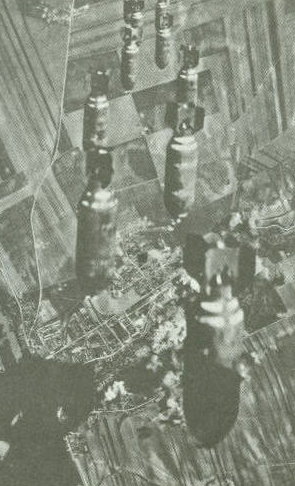
On one mission alone, 69 Allied bombers were shot down, each with a 10-man crew aboard. Three times Fleming returned to his barracks to find that his crew members were the only ones to make it back.

Even now, almost 50 years after the fact, he remembers the feeling of living from mission-to-mission.

"You got to where you didn't want to get to know anybody too well," he recalls. "If you made friends, it made it even harder to handle the losses."


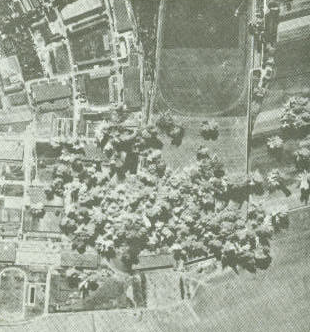
Precision Bombing At It's Best

But the common bond that danger and uncertainty forged proved to be a strong one for the young aviator and his fellow crew members. He says of the six surviving members of his original crew, "We're closer together than people I've known my whole life, and we didn't know each other but about nine months."

On his 26th mission, Fleming was hit in the right leg by a piece of flak. He received his Purple Heart in the mail in 1984. "It must have taken them that long to decide if I should have a Purple Heart or not," Fleming laughs. "Then again, it could have been mailed in 1944."


On fire, a brave B-17 Flying Fortress crew hold their position and bore into the target at all costs (Berlin, 6 March 1944)
When the young Lt. Fleming - in his mid-20s the "old man" of his group - arrived in England, an instructor told him that he'd never live through his 30 missions. The odds were that was an accurate prediction.

Reflecting on all the near-misses he experienced, he attributes his survival in part to luck, "being in the right place at the right time." But he also credits his survival to his dreams. "I had hopes and plans," he says. "I think that's what kept me stable in a situation that many others did not survive."

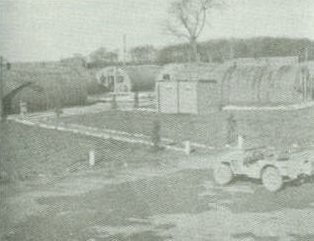
"Pneumonia Hill", Molesworth, England (home away from home)

Saturday, May 22, 2010

Damaged B-17 Lands Safely After German Pilot Declined to Shoot it Down

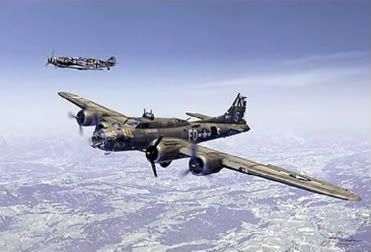
This is a painting of the incident - read on .......


Look closely at the B-17 and note how shot up it is - one engine dead, tail, horizontal stabilizer and nose shot up... It was ready to fall out of the sky. (This is a painting done by an artist from the description of both pilots many years later.) Then realize that there is a German ME-109 fighter flying next to it. Now read the story below. I think you'll be surprised ....

Charlie Brown was a B-17 Flying Fortress pilot with the 379th Bomber Group at Kimbolton, England . His B-17 was called 'Ye Old Pub' and was in a terrible state, having been hit by flak and fighters. The compass was damaged and they were flying deeper over enemy territory instead of heading home to Kimbolton.

Charlie Brown
After flying the B-17 over an enemy airfield, a German pilot named Franz Stigler was ordered to take off and shoot down the B-17. When he got near the B-17, he could not believe his eyes. In his words, he 'had never seen a plane in such a bad state'. The tail and rear section was severely damaged, and the tail gunner wounded. The top gunner was all over the top of the fuselage. The nose was smashed and there were holes everywhere.
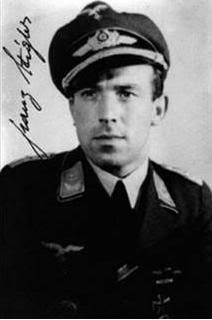
Despite having ammunition, Franz flew to the side of the B-17 and looked at Charlie Brown, the pilot. Brown was scared and struggling to control his damaged and blood-stained plane.

Franz Stigler
Aware that they had no idea where they were going, Franz waved at Charlie to turn 180 degrees. Franz escorted and guided the stricken plane to, and slightly over, the North Sea towards England . He then saluted Charlie Brown and turned away, back to Europe . When Franz landed he told the CO that the plane had been shot down over the sea, and never told the truth to anybody. Charlie Brown and the remains of his crew told all at their briefing, but were ordered never to talk about it.
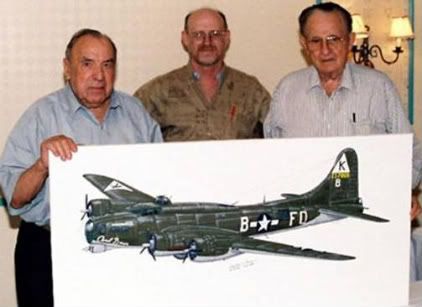
More than 40 years later, Charlie Brown wanted to find the Luftwaffe pilot who saved the crew. After years of research, Franz was found. He had never talked about the incident, not even at post-war reunions.

They met in the USA at a 379th Bomber Group reunion, together with 25 people who are alive now - all because Franz never fired his guns that day.

(L-R) German Ace Franz Stigler, artist Ernie Boyett, and B-17 pilot Charlie Brown.

When asked why he didn't shoot them down, Stigler later said, "I didn't have the heart to finish those brave men. I flew beside them for a long time. They were trying desperately to get home and I was going to let them do that. I could not have shot at them. It would have been the same as shooting at a man in a parachute."

Research shows that Charlie Brown lived in Seattle and Franz Stigler had moved to Vancouver, BC after the war. When they finally met, tey discovered they had lived less than 200 miles apart for the past 50 years.

Saturday, March 20, 2010

Project 44: The Belly Landing

Returning from the Oldenburg mission, the crew of B-17G #42-97214 (GD-C) "Carolina Queen" was unable to lower its landing gear due to a structural failure of the landing gear motor.

Landing a B-17 without its gear lowered is a problem because of the Sperry ball turret, which would prevent a smooth belly landing. For emergencies such as this, crews were supposed to carry special tools to drop ball turret. However, on this April day, the Bond crew did not have those tools on board and the story of how they got them, unfastened the ball turret, and made a successful landing became an article for the Public Relations Officer and was picked up in state side papers and by "Stars and Stripes".

How it all started - this is the statement of the pilot, Leslie Bond, taken from Accident Report No. 44-4-8-520.

"On April 8, 1944 while acting as pilot on ship 42-97214, B-17G, the landing great failed to retract electrically on take-off and was cranked up manually. On returning from the mission I tried to lower the gear electrically, but it would not lower. The engineer [S/Sgt Clyman] cranked the left gear down and tried to lower the right but it would not lower. When we came over the field and the squadron peeled off to land. I flew on out from the base and climbed to 4,000 feet and circled over the field and contacted the tower for instructions. I was asked if we had tools aboard with which to salve the ball turret. We did not have any, so the tower to me to stand by and Colonel Hall came up in an A-20 with a tool kit on a rope and tried to lower it to us. The bag broke before we were able to get it. He then returned to the base and got a longer rope and more tools. He lowered the tools to us and the engineer got them through the radio hatch. We then flew out to the channel and dropped the ball turret, returned to the field and made a crash landing on the runway."

The Engineering Officer, Capt Edgar C. Kurner added the following: "Investigation revealed shaft had sheared on retracting motor clutch housing. Unsatisfactory Report has been submitted on design of landing gear motor shaft. Damage to aircraft was negligible."

Lt. Col. Conway S. Hall (534th BS C.O.) tells how after the first attempt he landed to get a longer rope and an aircraft capable of flying better formation with the B-17. The aircraft he returned in was B-17E #41-9043 "Little Rock-ette". This aircraft was used as the group's auxiliary aircraft, it was stripped of armor and weapons. Without the excess weight, it was quite fast. The aircraft is shown here. The nose and engine nacelles were painted red with a red stripe that runs along the fuselage past the wings and terminates near the waist.

Lt. Col. Hall also tells how he flew in formation 50 feet above and slightly ahead of the "Carolina Queen" while someone else lowered the bag of tools. "I instructed the pilot [Lt. Bond] to keep looking straight ahead during this maneuver and not to look at me. Afterwards, we made sure every aircraft in the squadron had those tools aboard!"

Which aircraft was first flown seems to be in question. Lt. Bond and other sources indicate it was a Douglas A-20 Havoc, but Col. Hall recalled at the 1999 Houston Reunion that it was a Vultee A-35 that he had "liberated". Both aircraft were auxiliary birds at Ridgewell. To his credit these events did take place 56 years ago. I intend to interview him again to gather more of his recollections.

This picture of Conway Hall was taken at the 381st BGMA 1999 Reunion in Houston, Texas.


From Neal Clyman's hometown paper in Bloomfield, Iowa.


...Lt. Col. Hall, Little Rock, Ark., took off in another Fortress with the required tools and a rope to drop them into the hatch of the disabled bomber circling the field. The first try failed because the rope was too short. Sgt. Clyman got hold of it once, but it nearly jerked him out of the "Carolina Queen."

The next time, Hall used a three hundred foot rope and weighted the tools with a sandbag. Clyman, tying himself to his own bomber, hooked the tools while another gunner cut the rope with a knife.

The pilot of the crippled Fortress then flew the plane out over the North sea and the ball turret was dropped, which then permitted the "Carolina Queen," to make a successful crash landing.

"Snagging those tools was just like threading a needle in midair," members of the Fortress crew agreed.

"Mr. And Mrs. Clyman first learned of their son's heroic exploit from a radio broadcast which was also heard by several other Bloomfield acquaintances of the local airman. Accounts of the episode involving Sergeant Clyman have also appeared in several newspapers throughout the nation."

Dropping the Ball Turret in Flight (taken from the B-17 technical orders)

When preparing to bring the B-17 in for an emergency wheels-up landing it is desirable to drop the ball turret in order to minimize damage to the fuselage when it hits the ground.

It is both safer and easier to release only the ball itself, leaving the supporting yoke intact. Only 2 tools--a crescent wrench and a hammer--are needed to do the job. Two men can accomplish it in approximately 20 minutes.

(1) Turn the guns aft and down.

(2) Remove the azimuth gear case by taking out four bolts which hold it.

(3) Remove the safety retaining hooks with a socket wrench if available, or by breaking them off with a hammer.

(4) If there is time, disconnect the electrical plug and the oxygen line.

(5) Drop the turret by removing the twelve yoke connection nuts. The turret may land up on the fire cut-off cam, but a swift kick from the aft side of the ball will dislodge it.

NOTE: If time permits, salvage the computing sight before dropping the turret. Removal of the sight may add approximately 20 minutes to the time, making total time necessary for the operation about 40 minutes.

To remove the sight, disconnect the three flexible drive cables at the left, right and far sides of the sight. Disconnect the electrical plug. Free the sight by removing the sight retaining rod.

Remember these 3 rules for making emergency landings to minimize structural damage:

1. When landing the B-17 with wheels retracted, drop the ball turret.

2. When belly-landing a B-17 in which a chin turret is installed, retract the tailwheel also.

3. With 3/4 flaps down.

The AAF version titled "Better Late Than Never" is quoted here:

51925 USAF - BETTER LATE THAN NEVER - Five hours after the other ships in the group had returned from a bombing mission over Oldenberg, Germany, April 8, 1944, the Boeing B-17 Flying Fortress "Carolina Queen" pilot[ed] by Lt. Leslie A. Bond of Chickasha, Okla., came sliding home in a flawless belly landing. Unable to lower the ship’s wheels to normal landing position, Lt. Bond was compelled to circle about until what is believed to be the first successful tool-passing job in the ATO was accomplished. Lt. Col. Conway S. Hall of North Little Rock, Ark., deputy group commander, piloted the Fortress from which special tools used to jettison "Carolina Queen’s" ball turret, were passed by cable to a crewman standing in the radio hatch of the latter ship. Patterned after the successful aerial refueling stunts of the old endurance fliers the wartime version was enacted. With tools so unusually provided "Carolina Queen" ball turret was able to be loosened and finally dropped over the English Channel. Lt. Bond returned to base and brought his ship in for a perfect landing, made easier on both pilot and plane by absence of obstructing fuselage straining under turret. Only damage was bent propeller and skinned under-carriage and it will be in the air very shortly.

Actual photos of the Carolina Queen coming in for the belly landing:


Photos of Lt. Col. Hall and the Bond crew on "Carolina Queen's" wing:


Front row (L-R): 1) Lt. Col. Conway S. Hall (534th BS CO, eventual CO of 381st BG - not a crew member), 2) 2nd Lt Leslie A. Bond - pilot, 3) 2nd Lt. Gerald O. Hilton - bombardier, 4) S/Sgt. Anthony A. Caserta - ball turret gunner.

Back row (L-R): 5) S/Sgt Neal V. Clyman - engineer & top turret gunner, 6) S/Sgt. William R. Jones Jr. - radio operator holding a white bag, 7) 2nd Lt. Charles E. Brumback - navigator, 8) Sgt. Robert K. Batchelder - tail gunner, 9) Sgt. Earl Ornduff - right waist gunner, 10) Sgt. A.C. Derrington - left waist gunner, 11) 2nd. Lt. Wilbur M. Mason - co-pilot.

Sunday, March 7, 2010

B-17 Bomber Under Attack

"They're coming at us, look out", stated the voice heard through the earphones of Staff Sergeant Charles R. Batdorf, U.S. Army Air Force, as he nervously scanned the skies for the approaching German fighter planes. He could hear the bursts of machine gun fire coming from the forward crew positions on the plane as his fellow crewmen attempted to fight back against the head-on attack of the German Me-109 fighter planes. Only seconds passed before he saw several of the German fighters fly by the right waist gunner window, which was his assigned crew position. They passed by so fast that he was not able to get off a shot. Immediately he knew something was wrong for he felt the plane slow and start to lose altitude. Over the intercom he heard the terse exchanges between the pilot and co-pilot. The head-on pass made by the fighters had set fire to the B-17's number two engine. The pilot of the bomber named "Sleepy Time Gal", Lieutenant Theodore MacDonald, had to drop out of formation and feather the prop of the burning engine.


The damaged aircraft soon found itself alone and vulnerable in unfriendly skies. The crew knew that falling behind would draw the attention of the Luftwaffe pilots who tended to always prey on the stragglers. The crew didn't have to wait long. With the number two engine feathered and on fire, the German fighters formed up for another pass. Before any of the crew could react, bullets riddled the nose and radio room and set fire to the number three engine. As Lieutenant MacDonald struggled to keep control of his aircraft he spoke to his crew over the intercom. "O.K., bail out". His statement ended with the alarm bell sounding inside the aircraft. A moment later, the voice of the navigator. Lieutenant John Moskowitz, came over the intercom, "Mac, the fire destroyed both our chutes." The plane carried only one spare parachute, which meant that with the two damaged chutes of the navigator and bombardier, the crew was still short one. MacDonald's voice was again heard over the intercom. "Stand by." The intercom was silent only for a second as co-pilot John Godsey's voice was heard "Mac, I think we'd better do something. We're on fire and with two engines out, we're losing altitude fast." MacDonald called over the intercom for Moskowitz to come back to the cockpit and take his chute and again issued orders for the rest of the crew to bail out. "Mac," Moskowitz called back to MacDonald, "I'm not taking your chute." "John, I'm in command of this aircraft and if anyone can make a crash landing with the ship in this condition, I can." MacDonald's tone of voice indicated there would be no further discussion. And there wasn't. Godsey, Moskowitz, Hams and engineer Technical Sergeant Merle Cline all exited the stricken plane through the hatch in the nose.


Coinciding with the activities of the four officers and the engineer in the forward section of the plane, were the activities of the five enlisted crewmen in the rear section of the plane. S/SGT Batdorf scanned to his left, toward the front of the aircraft, and noticed the radio operator, T/SGT Willie Rowden, busily making preparations to bail out. The radio room was badly shot up and Batdorf wondered how Willie could have escaped injury. S/SGT Wendell Dowell, the left waist gunner, and T/SGT Rowden realized that the ball turret had lost power and that the hatch allowing S/SGT William Valigura to get out o^ the ball was not facing the interior of the aircraft. The man inside the ball turret, located on the under side of the aircraft, was dependent on his buddies to unlock the hatch and allow him to get out. Without then-help he was essentially trapped inside the turret. Rowden and Dowell manually cranked the turret around to allow them access to the hatch from the interior of the aircraft. They released the locking levers and opened the hatch enabling S/SGT Valigura to climb back into the main part of the aircraft.

While Dowell and Rowden were working to get Valigura back into the aircraft, S/SGT Batdorf happened to glance out his right waist gun window and notice that the German fighters were attempting to come around again. He saw an Me-109 coming right at him. He grabbed his .50 caliber machine gun and pointed it straight at the nose of the oncoming German fighter and held down the trigger. A steady stream of bullets headed toward the fighter, but the German kept up his attack. Batdorf s pulse raced as the German drew closer.


Though the fighter had not yet opened up on the American bomber, Batdorf realized that at any moment he might be seeing German tracer bullets headed directly for him. The heavy machine gun continued to shudder in his hands, sending more bullets toward the attacking German Me-109. Suddenly there was an explosion as Batdorf saw the German plane erupt in a ball of fire. He had made his first kill, though he would never receive credit for it as no other American aircraft was around to witness the event. Batdorf let out a sigh of relief, then returned to the task of getting ready to bail out. As he turned to his right, and looked back in the direction of the tail gunner's position, he noticed the body of tail gunner, S/SGT Robert Alien.

Wounded in the hand, Alien had disconnected from the plane's oxygen and had attempted to crawl to the door next to the right waist gun position. As the plane was still at approximately 30,000 feet, he had passed out from lack of oxygen before being able to open the door. He now blocked the door and the remaining crewmembers were not able to get out. Recognizing that time was running out and that the burning, bomb-laden aircraft could potentially blow-up at any minute, Batdorf and Dowell rolled Alien away from the exit, opened the door and pushed their fellow crewmember clear of the doomed aircraft. Valigura, the ball turret gunner was next out of the door. Willie Rowden, the radio operator, headed toward the bomb bay, his designated exit station when he realized that the bomb bay was still fully loaded. He turned around and headed back toward the waist door and made his exit. Dowell was next to go. He moved to the tiny door, crouched down placing his hands on the sides of the doorway and jumped clear.

Batdorf then moved toward the door and as he prepared to exit, realized he had not yet put on his chute. He had been so preoccupied with the German fighter and then with moving Bob Alien out of the way, that he forgot to put on his own chute. He headed back to his station to get his chute, clipped it to the rings on the front of his harness straps, and looked around the aircraft. He saw no one. He was alone. Batdorf moved toward the waist door to make his exit He crouched down in the same manner as Dowell had and prepared to propel himself through the door. Just before he shoved himself out, the 19 year old kid from Pennsylvania thought to himself "Whose gonna tell Mom and Pop where I am?" With that, he buried himself through the door and into the cold, blustery sky above Nazi Germany.


An Airman


An Airman's Odyssey: Charles R. Bardorf - An Aerial Gunner and Prisoner of War in World War II


Staff Sergeant Charles R. Batdorf
Armorer-Gunner, 8th Air Force
731st Bomb Squadron, 452nd Bomb Group

Piggyback Hero

by Ralph Kinney Bennett

Tomorrow morning they'll lay the remains of Glenn Rojohn to rest in the Peace Lutheran Cemetery in the little town of Greenock, Pa., just southeast of Pittsburgh. He was 81, and had been in the air conditioning and plumbing business in nearby McKeesport. If you had seen him on the street he would probably have looked to you like so many other graying, bespectacled old World War II veterans whose names appear so often now on obituary pages.

But like so many of them, though he seldom talked about it, he could have told you one hell of a story. He won the Distinguished Flying Cross and the Purple Heart all in one fell swoop in the skies over Germany on December 31, 1944.

Fell swoop indeed.

Capt. Glenn Rojohn, of the 8th Air Force's 100th Bomb Group, was flying his B-17G Flying Fortress bomber on a raid over Hamburg. His formation had braved heavy flak to drop their bombs, then turned 180 degrees to head out over the North Sea.

They had finally turned northwest, headed back to England, when they were jumped by German fighters at 22,000 feet. The Messerschmitt Me-109s pressed their attack so closely that Capt. Rojohn could see the faces of the German pilots.

He and other pilots fought to remain in formation so they could use each other's guns to defend the group. Rojohn saw a B-17 ahead of him burst into flames and slide sickeningly toward the earth. He gunned his ship forward to fill in the gap.

He felt a huge impact. The big bomber shuddered, felt suddenly very heavy and began losing altitude. Rojohn grasped almost immediately that he had collided with another plane. A B-17 below him, piloted by Lt. William G. McNab, had slammed the top of its fuselage into the bottom of Rojohn's. The top turret gun of McNab's plane was now locked in the belly of Rojohn's plane and the ball turret in the belly of Rojohn's had smashed through the top of McNab's. The two bombers were almost perfectly aligned - the tail of the lower plane was slightly to the left of Rojohn's tailpiece. They were stuck together, as a crewman later recalled, "like mating dragon flies."


No one will ever know exactly how it happened. Perhaps both pilots had moved instinctively to fill the same gap in formation. Perhaps McNab's plane had hit an air pocket.

Three of the engines on the bottom plane were still running, as were all four of Rojohn's. The fourth engine on the lower bomber was on fire and the flames were spreading to the rest of the aircraft. The two were losing altitude quickly. Rojohn tried several times to gun his engines and break free of the other plane. The two were inextricably locked together. Fearing a fire, Rojohn cuts his engines and rang the bailout bell. If his crew had any chance of parachuting, he had to keep the plane under control somehow.

The ball turret, hanging below the belly of the B-17, was considered by many to be a death trap - the worst station on the bomber. In this case, both ball turrets figured in a swift and terrible drama of life and death.

Staff Sgt. Edward L. Woodall, Jr., in the ball turret of the lower bomber, had felt the impact of the collision above him and saw shards of metal drop past him. Worse, he realized both electrical and hydraulic power was gone.

Remembering escape drills, he grabbed the handcrank, released the clutch and cranked the turret and its guns until they were straight down, then turned and climbed out the back of the turret up into the fuselage.

Once inside the plane's belly Woodall saw a chilling sight, the ball turret of the other bomber protruding through the top of the fuselage. In that turret, hopelessly trapped, was Staff Sgt. Joseph Russo. Several crewmembers on Rojohn's plane tried frantically to crank Russo's turret around so he could escape. But, jammed into the fuselage of the lower plane, the turret would not budge.

Aware of his plight, but possibly unaware that his voice was going out over the intercom of his plane, Sgt. Russo began reciting his Hail Marys.

Up in the cockpit, Capt. Rojohn and his co-pilot, 2nd Lt. William G. Leek, Jr., had propped their feet against the instrument panel so they could pull back on their controls with a ll their strength, trying to prevent their plane from going into a spinning dive that would prevent the crew from jumping out.

Capt. Rojohn motioned left and the two managed to wheel the grotesque, collision-born hybrid of a plane back toward the German coast. Leek felt like he was intruding on Sgt. Russo as his prayers crackled over the radio, so he pulled off his flying helmet with its earphones.

Rojohn, immediately grasping that crew could not exit from the bottom of his plane, ordered his top turret gunner and his radio operator, Tech Sgts. Orville Elkin and Edward G. Neuhaus, to make their way to the back of the fuselage and out the waist door behind the left wing.

Then he got his navigator, 2nd Lt. Robert Washington, and his bombardier, Sgt. James Shirley to follow them. As Rojohn and Leek somehow held the plane steady, these four men, as well as waist gunner Sgt. Roy Little and tail gunner Staff Sgt. Francis Chase were able to bail out.

Now the plane locked below them was aflame. Fire poured over Rojohn's left wing. He could feel the heat from the plane below and hear the sound of .50 caliber machinegun ammunition "cooking off" in the flames. Capt. Rojohn ordered Lieut. Leek to bail out. Leek knew that without him helping keep the controls back, the plane would drop in a flaming spiral and the centrifugal force would prevent Rojohn from bailing. He refused the order.

Meanwhile, German soldiers and civilians on the ground that afternoon looked up in wonder. Some of them thought they were seeing a new Allied secret weapon - a strange eight-engined double bomber. But anti-aircraft gunners on the North Sea coastal island of Wangerooge had seen the collision. A German battery captain wrote in his logbook at 2:47 p.m.: "Two fortresses collided in a formation in the NE. The planes flew hooked together and flew 20 miles south. The two planes were unable to fight
anymore. The crash could be awaited so I stopped the firing at these two planes."

Suspended in his parachute in the cold December sky, Bob Washington watched with deadly fascination as the mated bombers, trailing black smoke, fell to earth about three miles away, their downward trip ending in an ugly boiling blossom of fire.

In the cockpit Rojohn and Leek held g rimly to the controls trying to ride a falling rock. Leek tersely recalled, "The ground came up faster and faster. Praying was allowed. We gave it one last effort and slammed into the ground."

The McNab plane on the bottom exploded, vaulting the other B-17 upward and forward. It hit the ground and slid along until its left wing slammed through a wooden building and the smoldering mass of aluminum came to a stop.

Rojohn and Leek were still seated in their cockpit. The nose of the plane was relatively intact, but everything from the B-17's massive wings back was destroyed. They looked at each other incredulously. Neither was badly injured.

Movies have nothing on reality. Still perhaps in shock, Leek crawled out through a huge hole behind the cockpit, felt for the familiar pack in his uniform pocket and pulled out a cigarette. He placed it in his mouth and was about to light it. Then he noticed a young German soldier pointing a rifle at him. The soldier looked scared and annoyed. He grabbed the cigarette out of Leek's mouth and pointed down to the gasoline pouring out over the wing from a ruptured fuel tank.

Two of the six men who parachuted from Rojohn's plane did not survive the jump. But the other four and, amazingly, four men from the other bomber, including ball turret gunner Woodall, survived. All were taken prisoner. Several of them were interrogated at lengt h by the Germans until they were satisfied that what had crashed was not a new American secret weapon.

Rojohn, typically, didn't talk much about his Distinguished Flying Cross. Of Leek, he said, "In all fairness to my co-pilot, he's the reason I'm alive today."

Like so many veterans, Rojohn got back to life unsentimentally after the war, marrying and raising a son and daughter. For many years, though, he tried to link back up with Leek, going through government records to try to track him down. It took him 40 years, but in 1986, he found the number of Leek's mother, in Washington State.

Yes, her son Bill was visiting from California. Would Rojohn like to speak with him? Two old men on a phone line, trying to pick up some familiar timbre of youth in each other's voice. One can imagine that first conversation between the two men who had shared that wild ride in the cockpit of a B-17.

A year later, the two were re-united at a reunion of the 100th Bomb Group in Long Beach, Calif. Bill Leek died the following year.

Glenn Rojohn was the last survivor of the remarkable piggyback flight. He was like thousands upon thousands of men -- soda jerks and lumberjacks, teachers and dentists, students and lawyers and service station attendants and store clerks and farm boys -- who in the prime of their lives went to war in World War II. They sometimes did incredible things, endured awful things, and for the most part most of them pretty much kept it to themselves and just faded back into the fabric of civilian life.

Capt. Glenn Rojohn, AAF, died last Saturday after a long siege of illness. But he apparently faced that fina l battle with the same grim aplomb he displayed that remarkable day over Germany so long ago. Let us be thankful for such men.


A great story. I wonder how many more stories like this one are lost each day as members of the Greatest Generation pass on.

Saturday, February 27, 2010

Flak in World War II

By: Author Unknown
Date: 1999-11-03
Reprinted by permission of the 773rd Hostiles and Chuck "Creamo" Kremer.


This story was originally sent to Central of the 773rd Hostiles by one of the American Heroes from W.W.II, Willard "HAP" Reese: Pilot of B17 flying fortress. This article has been reposted here by permission of the 773rd Hostiles and Chuck "Creamo" Kremer.

Many stories have been written about the gallant defenses and the huge losses that were sustained by the Eighth Air Force as a result of Luftwaffe attacks on our bomber formations. And, to be sure, they were especially devastating and very often resulted in major losses of bombers and crews.

Aircrew gunners have written time and again of the exchanges between their 50 caliber guns and the 20 millimeter cannons of the enemy and how bomber crews had fought off enemy planes and persisted in spite of the attacks. The "Memphis Belle" and "Twelve O'clock High" films are testaments to the tenacity of aerial combat.

I'm sure, however, that when the records are finalized and one looks closely at the losses, it will be determined that more B-17's were lost to antiaircraft fire than to FW190's or ME109's. One could not shoot back at "Flak" so it tended to be less glorious -- but nonetheless deadly.

Whenever there was heavy overcast we would encounter barrage type flak, that is, all antiaircraft guns were controlled by a central radar unit and all fired simultaneously causing hundreds of shell bursts in one general area and at one specific altitude. This was the kind of flak that was described as "heavy enough to walk on" -- and was the most deadly if it happened to be accurately placed.

On a clear day, when the antiaircraft gunners could see our formation, they were cleared to fire at any plane which they might pick out and adjust the direction and altitude of their shell bursts as they fired and as might be necessary. The quality of the German antiaircraft guns and the skill of their gunners made life miserable for those of us who had to fly straight and level through a sea of bursting flak and flying shrapnel. If "practice makes perfect", then the German gun crews were the best. Here is a typical German battery of four 88 milimeter antiaircraft guns and their crews firing in unison (barrage).

The following is about one of our many encounters with flak. It's about a German gun crew firing at a plane almost five miles above them. A gun crew whose accuracy and persistence almost brought to an end the tour of one crew of ten men in a B17 named "That's My Baby".


That's My Baby: February 16, 1945

This particular encounter occurred on Feb. 16th, 1945. It was our twenty-fourth mission and our target on this date was the synthetic oil facilities at Gelsenkirchen, Germany. The route of the 457th was on course and on schedule. The visibility in the target area was crystal clear with only light cloud cover at about 5000 feet. From the initial point to the target the flak was extremely heavy and accurate, something we had come to expect on a clear day such as this.

But this day, moreso than others, it seemed that each shell was bursting immediately adjacent to us and with each burst our plane shuddered a little as if fatally hit. Every plane in the squadron was taking a murderous beating from the flak.

Midway on the bomb run the deputy lead plane in the low box sustained a direct hit in his port wing between the number two engine and the fuselage. Almost immediately the wing folded up and broke off, almost colliding with another plane. The two parts of the plane spiraled out of control with fire billowing from each part as it fell. No one in our crew saw any parachutes. The intercom was ominously quiet. Weeks later we learned that six of the crewmen did not survive.

It was not unusual, after a visual bomb run with heavy flak, for the formation to break after dropping its bombs. Each plane would take its own evasive action to try to avoid the flak and then later reassemble with the squadron after leaving the target area. We felt safe from Luftwaffe fighters at this time since any attack while we were in the target area would also expose them to their own friendly flak fire.

On this day, immediately after dropping our bombs, we broke formation to the right from the high box and immediately were tracked by a single antiaircraft gun. The flak bursts were directly in front of the nose of our plane -- one after the other in rapid succession about 3 seconds apart. It seemed they were no more than 50 feet in front of the nose of our plane. The black bursts were unusually large and we were instantly engulfed in the residual smoke from the burst. We dove sharply and the flak followed.

We turned as tightly as a B17 can turn and the flak followed directly in front of us. Then suddenly we were hit. The explosion was in the nose compartment of the plane where the navigator and bombardier were located. Even with our helmets and headphones on, the sound was deafening. A fierce, cold wind suddenly blew through the pilot's compartment.

A quick glance at the instrument panel told me that engine number three had been hit. The oil pressure was dropping rapidly. Flying bits of aluminum gave me a clue that there was damage overhead in the pilots compartment and our instrument panel now had a major dent from the force of shrapnel hitting the forward side of the panel.

We immediately feathered engine #3 and cut the switches. Oil was streaming from the engine nacelle. I tried to contact Joel Lester in the forward compartment but could not. The silent intercom to the navigator's compartment only reinforced my belief that we had sustained major injuries.....or worse.

My worst fears were relieved when Joel's head appeared through the opening leading from the nose compartment to the flight deck. His oxygen mask had been blown off by the force of the wind and he was asking the flight engineer to get him the emergency portable oxygen bottle. We were still at 20,000 feet altitude and oxygen was an imperative. Joel shouted to me that he and the navigator "didn't have a scratch" but were about to freeze from the blast of subzero air now blowing through the front of the plane. The flak bursts were still coming but we were almost out of the range of the gun and were no longer concerned with evasive action.

A quick look upward told me that some flak had penetrated the fuselage above my head and there were several nicks in the bullet resistant glass of the windshield that had not been there before. Our bombardier and navigator crawled out of the nose and retreated through the pilots compartment to the radio room.

From the rush of cold air we knew there was a major opening in the nose of the plane and the acrid smell of gunpowder lingered in the air. The air temperatures at this altitude in the winter frequently exceeded 40 degrees below zero.

We were now down to about 16000 feet and far from our squadron which was reassembling several thousand feet above us. With only three engines we were never able to catch up with our group but we were able to keep them in sight till we reached the English coast. Again we were fortunate that no fighters were in the area as the physical condition of our plane and our isolated location was a 'made-to-order' type kill for them.

Our bombardier, Joel, having found a throat mike and helmet in the radio room, proceeded to update me on what had happened. He reported that the burst had not been in the nose but directly in front of it. The shrapnel had shattered the plexiglas nose, damaged the bomb sight, and sprayed the nose compartment with deadly pieces of flying metal. It had miraculously spared both he and the navigator.

It seems that one of the pieces of shrapnel had hit a 50 caliber ammunition box on the floor adjacent to his foot and had exploded several shells which, in turn, had blasted a hole through the aluminum fuselage of the nose compartment without injuring him.

After crossing the Dutch coast we dropped down to about 2000 feet over the North Sea where the air temperature was considerably warmer. It had become unbearably cold in the pilot's compartment and, although it was February, the blast of air now flowing through our compartment felt comfortably warm.

We continued to Glatton on our three engines and landed without incident.

As I loosened my parachute to leave my seat and review the damage first hand, I observed that the flak fragment that had pierced the fuselage almost directly above my head had indeed come close. It was lodged in my parachute directly behind my left shoulder. I later dug out the fragment and still have it today. A souvenir of a close call -- both to the plane, the crew, and to me.

A slow walk around the plane made me aware of how fortunate we had been. The front end of the plane suffered major damage. The plexiglas nose was almost completely gone. There was a hole just above and to the starboard side of the navigator's compartment about a foot in diameter (where our exploding 50's had exited) and the chin turret was inoperable.

Furthermore, one of the two 50 caliber guns veered off at a sharp angle from the other. Several other fragments had punctured the fuselage in the navigator compartment, the leading edge of the right wing, and the cowling of the number three engine.

This was one of many episodes with flak. I cannot recall a mission where we were not under fire from antiaircraft guns for at least a portion of the time we were over enemy territory. This time our plane suffered major damage but none of the crew was scratched. We had a few silent prayers of thanks as we returned to our hut that night.

Addenda:

The following is an excerpt from official War Dept. document about "Flak" and the results of flak on the air war over Europe.

Fliegerabwehrkanonen ( FLAK ) Ack-Ack

The accuracy and effectiveness of FLAK or anti-aircraft artillery fire was derided at the start of the war but it gained a healthy respect as the war dragged on. By 1942 15,000 88mm ( 3.46 in ) guns formed the bulk of heavy flak defenses for Germany. Large numbers of 37mm ( 1.47 in ) and 20mm ( 0.79 in ) guns filled the skies with shells during every air raid. Often arrayed in "belts" around a city or target 88s could fire 22 lb ( 10 kg ) shells up to 35,000 ft ( 10,600 m ) at a rate of 15 - 20 rounds per minute.

The excellent 88mm ( 3.46 in ) gun proved very effective especially when radar was used to help with aiming. The shells exploded at a preset altitude sending metal splinters flying in all directions. Later groups of up to 40 heavy flak guns Grossbatterien fired rectangular patterns of shellbursts known as box barrages that proved very deadly to enemy bombers.

In 1944 Flak accounted for 3,501 American planes destroyed, enemy fighters shot down about 600 less in the same time period. More flak guns gradually appeared, mainly the 128mm ( 5 in ) German Flak accounted for 50 of the 72 RAF bombers lost over Berlin on the night of March 24th, 1944. An incredible 56 bombers were destroyed or crippled by flak during a B-17 raid on Merseburg in November of 1944.

My thanks go to Willard "HAP" Reese and all the Heroes of W.W.II for their sacrifices to keep us free. I would also like to thank Central, Creamo and all the 773rd Hostiles for sharing this article. Thanks to Leo "Central" Park for gathering the information.

See also B17 Navigator's Diary and our Military History Index. Visit the 303rd Bombardment Group

Printed from COMBATSIM.COM (http://www.combatsim.com/review.php?id=619&page=1)
 
Copyright © 2009, Michelle Deffinger [ Contact Me: Michelle Deffinger ]
Static Webpage Editor